- Published on
How to Use AI in Your Business: Good and Bad Practices
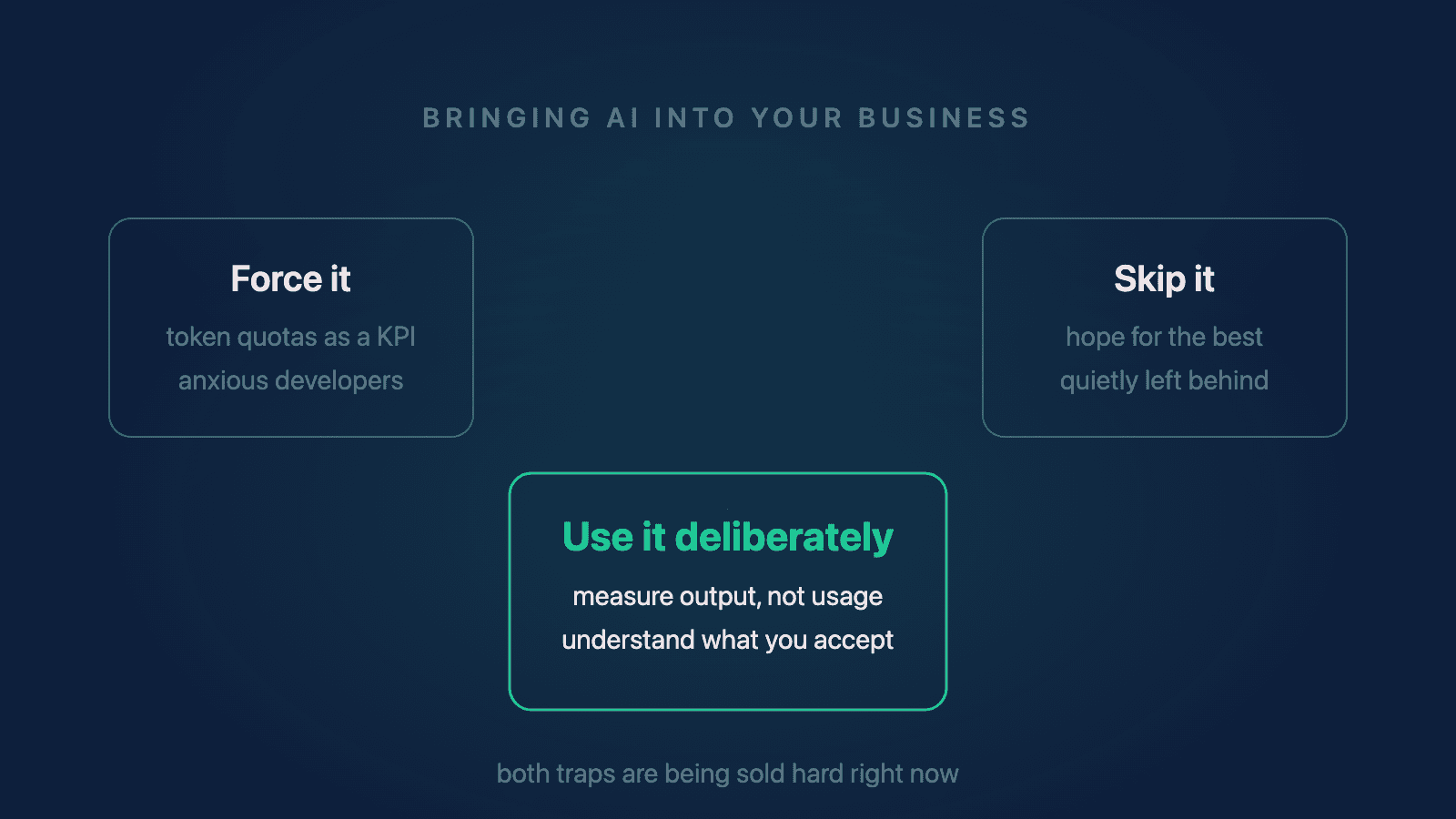
I wrote recently about whether AI actually makes your development team faster. This one is a level up from that: not what to expect once your team is using AI, but how to bring it into your business at all, and the ways I'm watching people get it wrong.
My stance hasn't changed. I don't think any industry is immune to what's happening. I meet with a lot of students down at the University of Arkansas, and between those conversations and the ones with colleagues and family, I keep landing in the same place: there's no career that isn't impacted right now, and no business that isn't impacted in one way or another.
So as a business owner you have two choices. You can ride the train and try to implement AI in some way, or you can do nothing and hope for the best. And the people doing the second thing are, from what I can see, the same people starting to lose business. If you'd told me a year ago how many people would be struggling because they weren't willing to accept the new times, I probably wouldn't have believed you. A year ago I believed people would struggle in the abstract; I didn't believe I'd be watching it happen to specific businesses this quickly.
That said, there's no single right way to bring AI into a team, and I'd be suspicious of anyone who claims there is. What there are, though, are some clearly good practices and some clearly bad ones. Let me start with the bad, because both of them are being pushed hard right now.
Bad practice: turning token spend into a performance metric
The high-level tech executives are all-in on usage as a virtue. The loudest version came from Nvidia CEO Jensen Huang, who said he'd be "deeply alarmed" if an engineer paid $500,000 a year wasn't consuming at least $250,000 worth of AI tokens, and compared not using AI to designing chips with paper and pencil. The message underneath: your best developers should be burning tokens like crazy, and if they aren't, something's wrong with them.
I think all that framing has actually created is anxiety. Developers, managers, and business owners now half-believe that if they don't use AI constantly, or don't use up their token budget, they're falling behind. That's not at all the case, and here's the thing: I catch this feeling in myself.
I recently did an entire website redesign for someone, and it took me maybe a day or two. And my honest first reaction was that I needed to do more, that a day or two of work wasn't enough. But if I stopped and thought about it for even a minute: that redesign would have taken me two to four months before. I condensed months into a couple of days, and my instinct was still to feel behind. That's what usage-as-a-metric does to people. We're doing phenomenal work compared to even a year ago, and we're simultaneously making people feel like it's never enough.
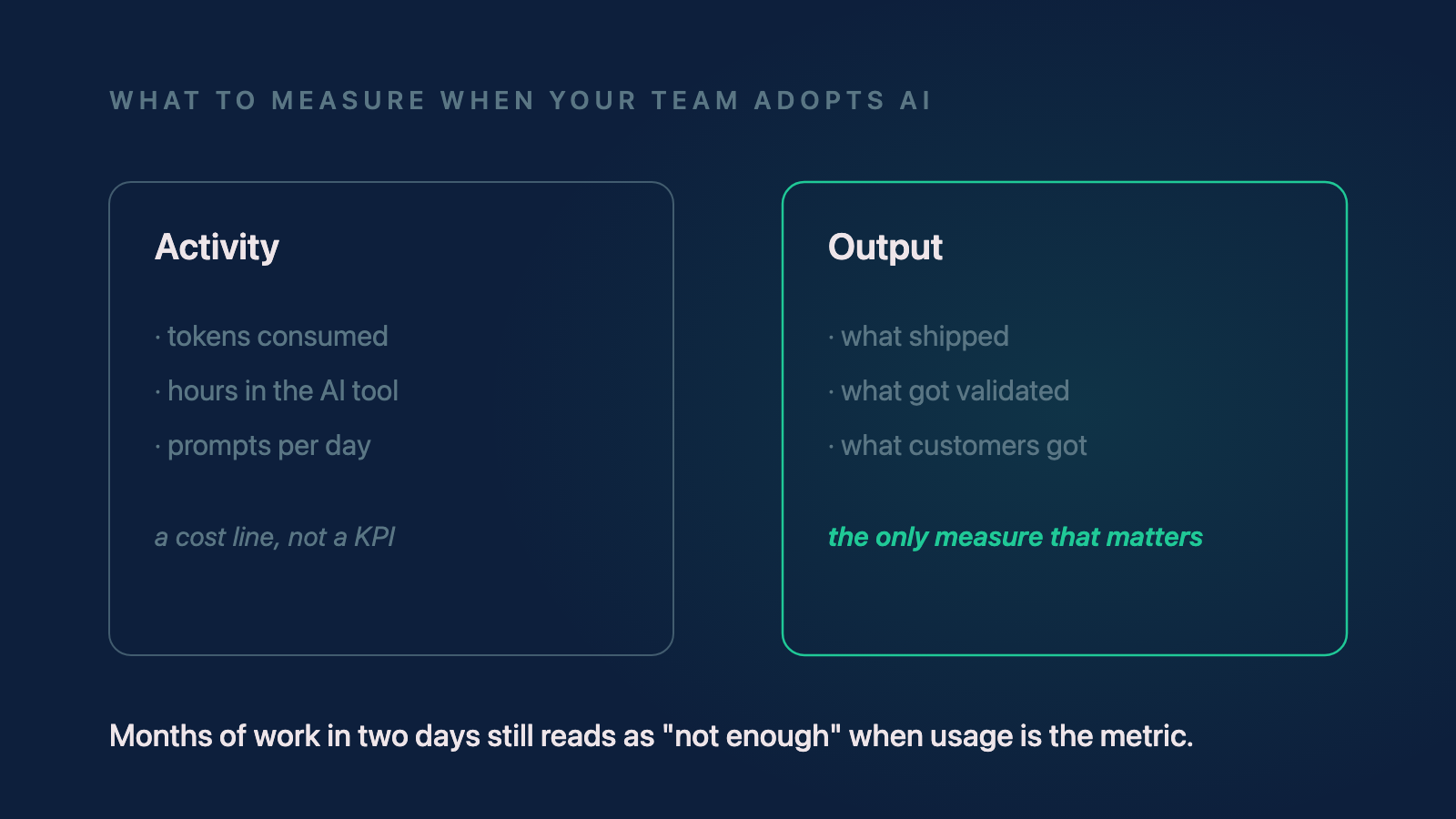 Token consumption measures activity. The only measure that matters is what got shipped and validated.
Measure output. Measure what shipped, what got validated, what your customers got. Token consumption is a cost line, not a KPI.
Bad practice: letting AI think for you
You see the term "AI slop" everywhere right now, and with good backing. But I think AI slop is the result, not the root cause. The root cause is that people treat AI as a quick solution and stop critically thinking. They have an idea, they get it out there fast, and they hope for the best. The slop is just what that looks like from the outside.
I notice it most with students. A software engineering student I talk with is genuinely thoughtful about his AI use: he has Cursor lay out the plan and explain what's going on, he reads through it, and only when he understands it does he let it implement. That's the right shape. But he's also transparent with me about the other days: "sometimes I really just don't get it, so I just let it run, because I need to get this project done and I don't have time to think about it."
That sentence is the whole problem in miniature. Not the tool, the habit. The foundational understanding that makes someone a strong developer or a strong business owner gets skipped because the output arrives either way.
And don't get me wrong, I'm not above this. I think most people who use AI daily suffer from some version of it, me included. It takes real effort to stop yourself and ask whether you actually understand the thing you just accepted. But that effort is exactly the moat. The people who keep doing it will be the ones who can tell good AI output from bad, and the people who don't are the ones producing the slop.
What the good practices look like
The good side, for me, comes down to three habits.
The first is just letting AI be fast at real tasks, because the speed is a significantly bigger deal than most people give it credit for. We've gone numb to it. A couple of weeks ago I had a pile of questions about one of my codebases, so I let Claude run with several agents, and it came back with a two-page write-up of what needed updating and changing. That's work that would have taken a few people going through and double-checking. It was done before I'd finished the other thing I was doing. We cannot discount how quick and capable these models are, even at very basic things.
The second is iterating on ideas in parallel instead of in sequence. When I have an idea now, I can come up with a plan, mock it up in Figma, run research on whether it's worth pursuing and how hard it'll be, and get to a yes or no without pulling anyone else off their work. If it's a yes, I hand the first features to an agent, walk away, and come back to the bare bones of what I asked for. If it's a no, I move on, and it cost nothing but my own attention. It never feels like I'm competing for somebody's time anymore, and that changes which ideas even get explored.
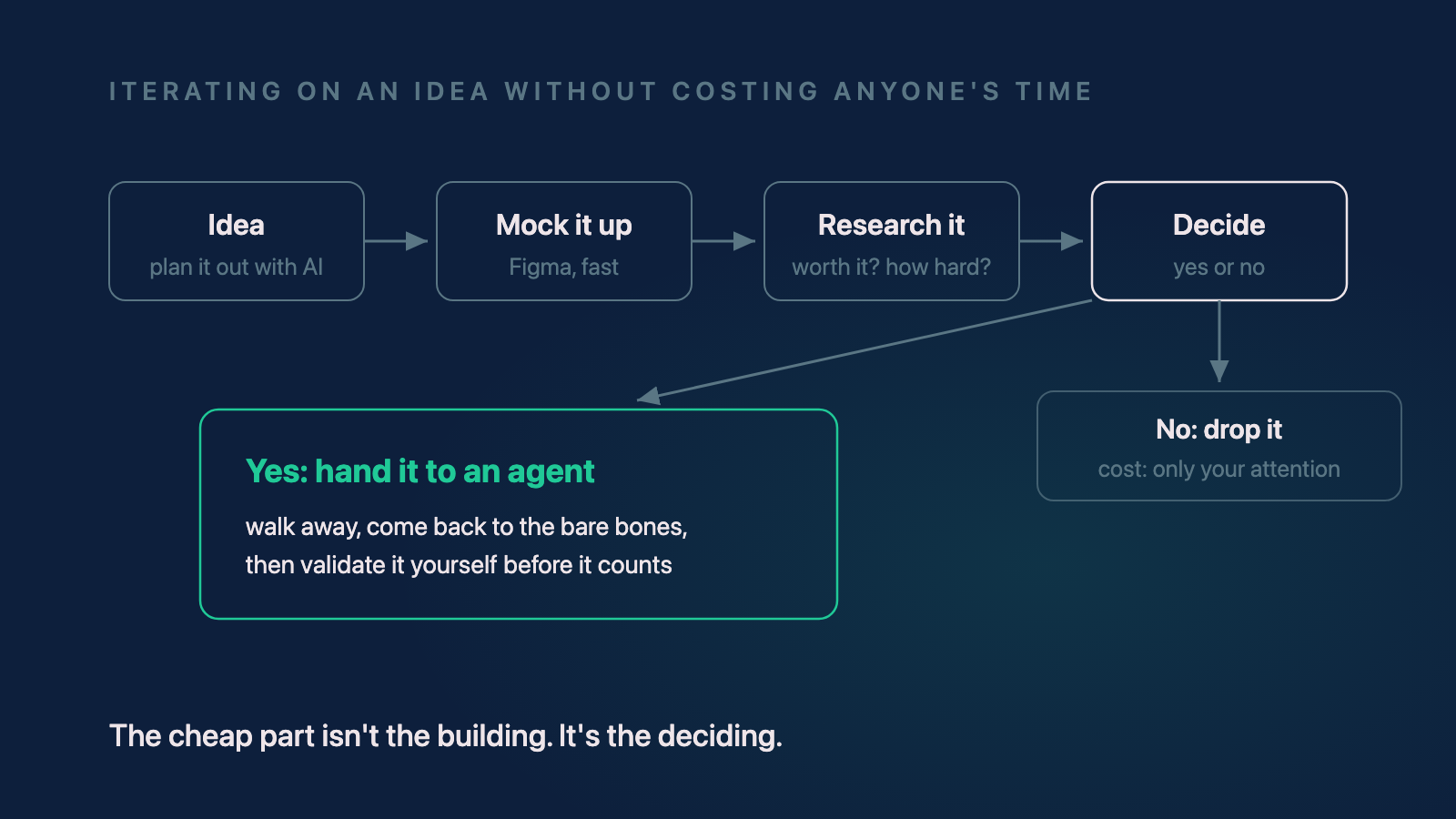 The cheap part isn't the building, it's the deciding. Ideas get a real evaluation without costing anyone else's time, and only the survivors get built.
The third is knowing where you personally need to stay in the loop. I know Claude has options for running remote agents you check in on from anywhere, and I'm still hesitant with them for certain work. A lot of what I do ends up being UI work, or actual database and API changes, and walking away from those without validating them feels wrong to me. Some people say just let it run and check afterward, and I get that. But I'm one of those people who wants to see it in real time, so I know whether something needs to change in that moment. As the models keep getting stronger and their reasoning improves, I'll probably loosen up on that. The point isn't my particular line; it's that you should know where yours is, on purpose, instead of discovering it after something ships broken.
What happens to the people who sit this out?
AI is here to stay. There's really nothing anyone can do to get rid of it, and if you can't get rid of it, you might as well use it. I understand people have principles and methodologies for why they won't. But you're not really helping yourself, and my honest fear is bigger than any one business: I think we're going to end up with a large group of people with no skills that transfer into an AI-shaped economy, because they didn't take the time now to learn it.
There is going to be job displacement. There has been some form of it in every century, with every technology that has come along, and that is part of how this economy works. But accepting that displacement happens is different from doing nothing to prepare for it. We're at the very front edge of what will eventually be looked back on as the AI wave, and right now is the moment where leveraging it is cheap and not leveraging it is quietly expensive.
These are my working thoughts, and some of this is subjective; where the right line sits between letting AI run and staying hands-on is going to be different for your team than for mine. But ride the train or hope for the best are really the only two options on the table, and I think the benefits of the first one outweigh the downsides by a wide margin. I think that's more true than not.
Need help with your project?
Chris Martinez
Founder of CAM Software · Mobile engineer
Chris founded CAM Software in 2022. He leads embedded product engineering engagements for established companies with mobile-led products, inherited applications, and delivery challenges. His work spans product alignment, React Native and native mobile engineering, supporting web and backend systems, release reliability, and responsible AI delivery. He also operates software products owned and operated by CAM Software from Northwest Arkansas and works with teams nationwide.